
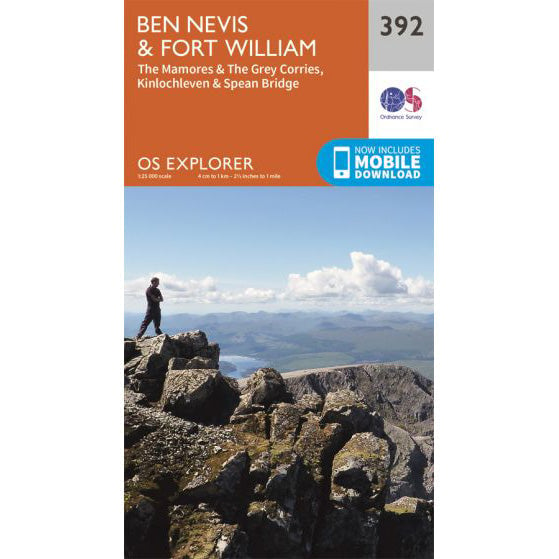

OS Explorer 392 map for Ben Nevis
Map and route reference for Ben Nevis and Fort William.
Ben Nevis is the highest mountain in the British Isles at 1,345 metres (4,413 feet). Located in the Scottish Highlands near Fort William, it attracts over 150,000 walkers each year.
| Height | 1,345 metres (4,413 feet) |
|---|---|
| Prominence | 1,344 metres |
| Location | Lochaber, Scottish Highlands |
| Grid Reference | NN 166 712 |
| Coordinates | 56.7969°N, 5.0036°W |
| OS Map | Explorer 392 (Ben Nevis and Fort William) |
| First Recorded Ascent | 1771, James Robertson (botanist) |
| Annual Visitors | Approximately 150,000 |
The name "Ben Nevis" comes from the Scottish Gaelic "Beinn Nibheis". The exact meaning is debated among scholars. Possible translations include:
The most commonly accepted interpretation relates to the mountain's tendency to have its summit shrouded in cloud - appropriate given the summit is in cloud over 80% of days.
Ben Nevis is the remains of an ancient volcano that was active approximately 350 million years ago during the Devonian period. The mountain is formed from the collapsed caldera of this volcano.
The rock is primarily granite, with the distinctive cliffs on the north face formed from this hard, weather-resistant material. The summit plateau sits on the collapsed magma chamber, while the surrounding peaks are the eroded remnants of the original volcanic cone.
The north face features cliffs up to 700 metres high - the highest cliffs in Britain - and contains some of the most challenging rock and ice climbing routes in the country.
The ruins visible on the summit plateau are the remains of a Victorian weather observatory that operated from 1883 to 1904. The observatory was built by the Scottish Meteorological Society and staffed year-round, with observers recording weather data that contributed significantly to the understanding of mountain meteorology.
Supplies were carried up by pony along the path that is now known as the Pony Track or Tourist Path. The observatory recorded some remarkable weather extremes:
The observatory closed in 1904 due to lack of funding. The buildings gradually deteriorated and are now reduced to low walls and foundations. A memorial cairn and trig point mark the highest point.
The first recorded ascent was by James Robertson, a botanist from Edinburgh, in 1771. However, local people would certainly have climbed the mountain before this date - the Pony Track follows an ancient route.
The construction of the observatory in 1883 transformed Ben Nevis from a remote wilderness peak into a site of scientific importance. The path was improved to allow pony access, making the mountain accessible to Victorian tourists.
The National Three Peaks Challenge, linking Ben Nevis with Scafell Pike and Snowdon, emerged in the mid-20th century. The challenge has grown significantly in popularity and is now one of the most popular outdoor challenges in Britain.
The Ben Nevis Race has been run annually since 1895 (with interruptions for wars). The current record for the race from Fort William to the summit and back is:
The fastest known completion of the National Three Peaks Challenge (all three summits) is under 10 hours, though records depend on the specific rules applied (e.g., whether support vehicles are used, whether the same person drives, etc.).
Ben Nevis has seen many unusual ascents over the years, including:
Despite the harsh conditions, Ben Nevis supports a range of wildlife and plant species:
The lower slopes support heather moorland, giving way to arctic-alpine plant communities at higher elevations. Rare species include:
Ben Nevis is part of the Ben Nevis and Glen Coe National Scenic Area and is owned by the John Muir Trust, a conservation charity. Visitors are encouraged to follow the Countryside Code and leave no trace of their visit.
Path erosion is an ongoing concern due to the high number of visitors. The main path has been extensively repaired and maintained, with work ongoing to manage the impact of foot traffic.
| Mountain | Height | Country | Ascent (from standard start) |
|---|---|---|---|
| Ben Nevis | 1,345m | Scotland | 1,352m |
| Scafell Pike | 978m | England | 989m |
| Snowdon | 1,085m | Wales | 723m (from Pen-y-Pass) |
Ben Nevis is both the highest summit and involves the greatest ascent, as the path starts close to sea level. This makes it the most demanding of the three mountains on most itineraries.
Map and route reference for Ben Nevis and Fort William.