
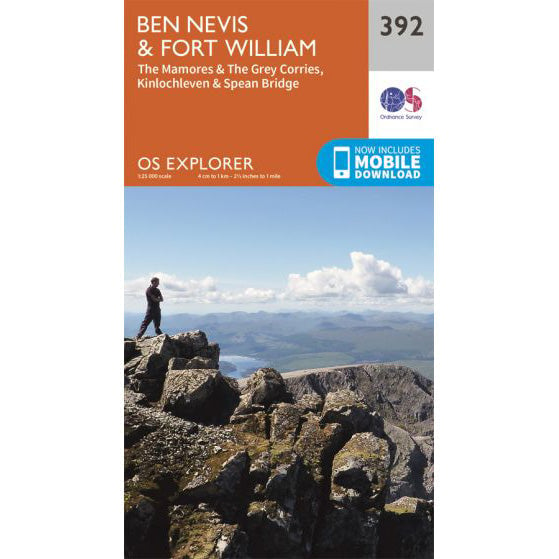

OS Explorer 392 map for Ben Nevis
Map and route reference for Ben Nevis and Fort William.
Ben Nevis has several routes to the summit. The Pony Track (Tourist Path) is the most popular and the route used for Three Peaks Challenges. Other routes exist but require greater experience, navigational skills or technical climbing ability.
The Pony Track, also known as the Tourist Path or Mountain Track, is the standard route up Ben Nevis. It was originally built in 1883 to service the observatory that once stood on the summit. The name comes from the ponies that carried supplies up the mountain.
There are two starting points for the Pony Track, both leading to the same route:
| Distance | 10.5 miles (17km) round trip |
|---|---|
| Ascent | 1,352 metres |
| Time | 7-9 hours |
The main starting point with better parking and facilities.
View route details| Distance | 9.5 miles (15km) round trip |
|---|---|
| Ascent | 1,352 metres |
| Time | 6-8 hours |
Slightly shorter with limited parking.
View route detailsThe summit plateau of Ben Nevis is notoriously dangerous in poor visibility. The flat, boulder-strewn top gives few clues to direction, and the northern cliffs drop away steeply with little warning.
In cloud or winter conditions, accurate compass bearings are essential for a safe descent. The standard advice is to follow a bearing of 231° (grid) for 150 metres from the trig point, then turn to 281° (grid) to avoid the cliffs and locate the top of the descent path.
GPS devices or smartphone navigation apps provide a useful backup to traditional navigation, but should not be relied upon as the sole means of navigation.
On guided National Three Peaks Challenge events, Ben Nevis is typically climbed during daylight hours. As the most demanding of the three mountains - with the greatest height and ascent - it requires good visibility and conditions. The extended daylight in the Scottish Highlands during summer means there is ample time to complete the ascent safely.
The other peaks (Scafell Pike and Snowdon) are often climbed during the night portions of the challenge, as they are shorter and have more straightforward navigation.
Several other routes reach the summit of Ben Nevis. These are not suitable for Three Peaks Challenges due to their length, technical difficulty or objective hazards, but may interest experienced hillwalkers and climbers.
The Carn Mor Dearg (CMD) Arete is a classic mountaineering route that traverses the narrow ridge connecting Carn Mor Dearg to Ben Nevis. The route involves scrambling (using hands for balance and progress) and requires good conditions and experience.
| Distance | Approximately 10 miles round trip |
|---|---|
| Ascent | Approximately 1,500 metres |
| Difficulty | Grade 1 scramble, exposed in places |
This route should only be attempted in good weather and by those with scrambling experience.
A scrambling route on the north face that follows a system of ledges to reach the summit plateau. More serious than the CMD Arete, with sections of Grade 2 scrambling and considerable exposure.
The north face of Ben Nevis holds snow and ice well into summer and is one of Scotland's premier winter climbing venues. Routes range from Grade I gullies to Grade VIII technical mixed climbs. These are serious mountaineering undertakings requiring full winter climbing equipment and experience.
The Pony Track can be walked year-round, but conditions vary dramatically by season:
Three Peaks Challenges run primarily from April to October, avoiding the most challenging winter conditions.
Map and route reference for Ben Nevis and Fort William.